Feeds:
Posts
Comments

Off to Karadou

Tomorrow, I will be stepping into native Papua New Guinea. I will be living among and learning the manners of PNG people. My post earlier this week outlines my location and details of my living arrangements. Now I want to share some of my village living goals and prayer concerns for the next five weeks. One assignment we have is to show the Jesus Film from the Book of Luke. It has been translated into the trade language of PNG, Tok Pisin. Each team will show the film in their village. Please pray for all 9 village teams who show the Jesus Film.

Note:  I will be without computer and electricity in my village living. I do plan on making one town trip so I may give a brief update at that time.

Village Living Goals:

Daily Devotions in the morning
Chance to share gospel message
Build Relationships
Memorize Tok Pisin scripture
Learn to climb a coconut tree
Become more comfortable speaking the language
Learn the behavior and ways of PNG

Prayer Requests:
The Spirit will walk with me daily in the village
Safety, Health, and Security in the village
God will present opportunities for me to be used
Jesus Film will be welcomed and received well
Continued Spiritual Growth

Praises:
Good course preparation here at POC
Successful 3 Day Hike
A good local wasfamili to help teach me
Good Health

3 Day Survey Hike

I am preparing for village living in which I will be gone for 5 weeks. This is my final week here at POC. I leave on Friday, March 25. I have been busy buying supplies and food for my village experience. Buying for 5 weeks of village living is hard as I have no experience living in the bush. I trust what my roommate and I have bought will be enough. One comfort food I have found in town are Oreo’s. I have bought a few packets that shall be a nice treat. My village allocation is south of Madang in the Transgogola area. The language group is Sihan and village name is Karadou. If you want to look up the specific location here are the GPS coordinates:
S              5.16.317
E              145.32.205
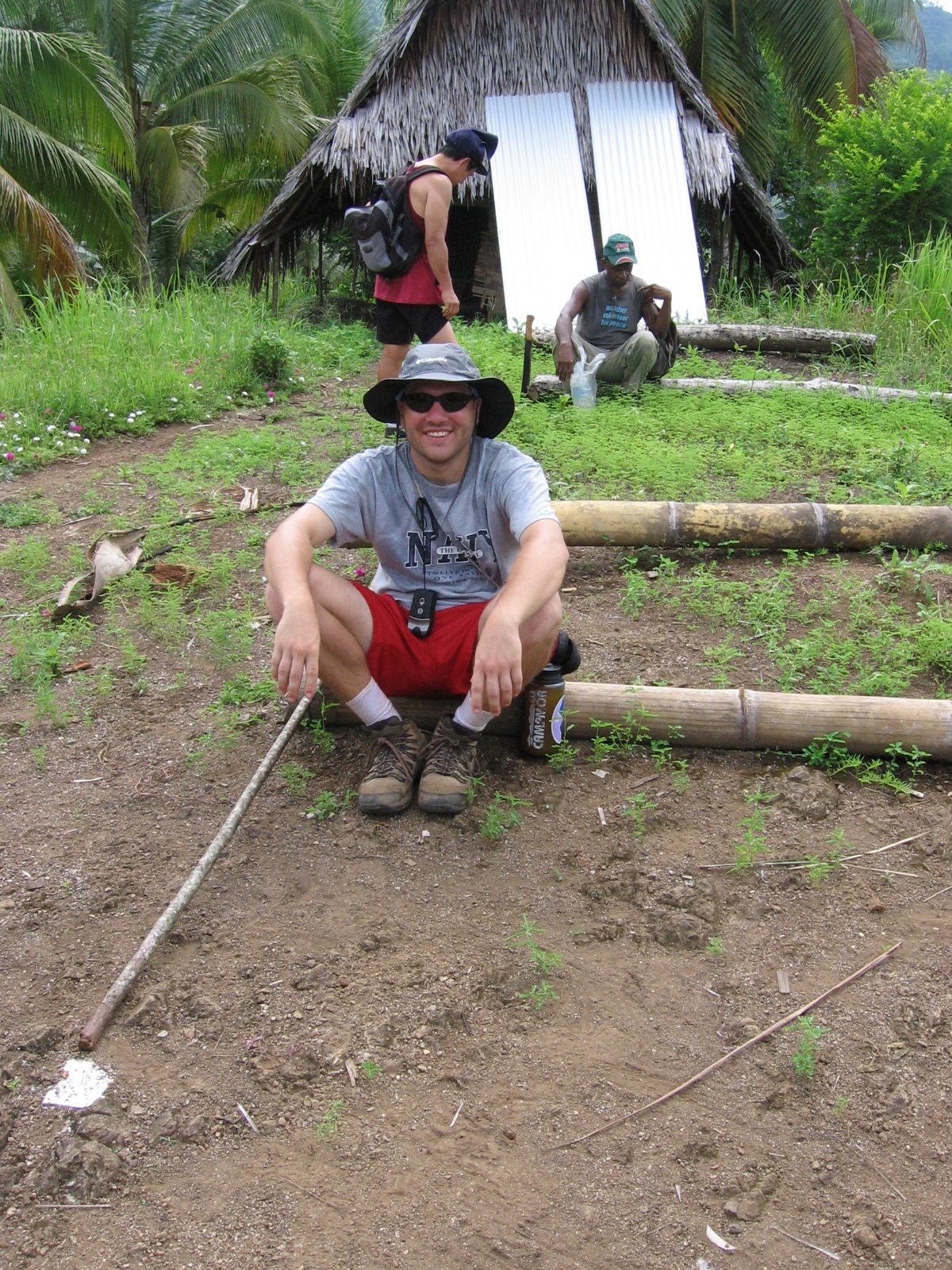
I will be staying in a hausboi which is a house built just for men. This house is approximately 7’x24’ split between 2 rooms. It is 6’ off the ground built on posts with a morota roof. Morota is woven leaf from a Sago tree. They usually weave 6’-8’ sections and overlap them like shingles. I am not sure the floor but more than likely bamboo or buai. The walls are typically woven bamboo blinds. Windows are cut and often open to the outside. Living in such an environment will definitely be an experience, one that I may or may not want to do again. I am reminded that being a follower of Christ, you are often called outside your comfort zone. Being a missionary, you are very much outside your so-called comfort zone of life.

Last week, we were split into groups of 5-6 for the 3 day survey hike. My group make up was 2 Papua New Guinea guides (1 male/1 female) and 5 students (3 Americans, and 2 Koreans). We left on Monday morning and returned mid afternoon on Wednesday. We had 2 village overnights on our survey hike. The first day we hiked 4.8 miles to Betelgut.
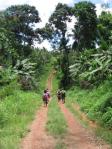
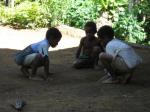
We got to Betelgut in the mid afternoon and the school kids just got out of school. Many of the young primary children were playing in the dirt yard. They were very entertained by the whiteskins in their village. 3 of the children were playing marbles on the dirt floor.
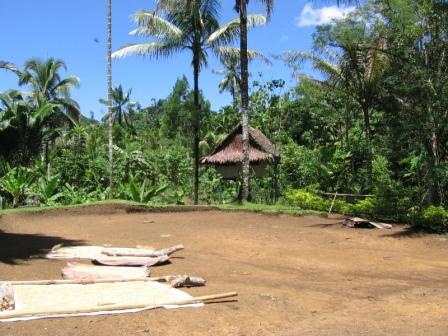
The picture has rice that is drying on the ground with the hausboi in the background where we stayed for the night. Once the rice has been dried, you husk the shell then you are ready to eat the rice.

That evening we sat on a big blue trap, ate dinner, drank coffee/tea, and then ate popcorn while we told stories. People here love to sit and share stories. They especially love to hear funny stories. They like to laugh but they are forgiven when we stumble over our broken Tok Pisin words. After a somewhat restless night, sharing a mosquito net with another man which was meant for a single the next morning came with gray clouds. The family said it was going to rain and they were right. It did rain so we waited for it to let up. We finally made a group decision to pack up and start on the trail. By this time the rain was a little drizzle and it soon dissipated while on the trail.

Day 2 was a long day, 8.1 miles over 6.5 hours going up and down through the jungle terrian. We were making our way along the ridge to the village of Balbul. We stopped at the village of Belan for lunch and a quick rest. We made it to Balbul about 4:30 in the afternoon. It was a very long, hot day on the trail carrying a 10 kg (22 lbs) backpack.

This village had a very nice creek that was available for washing. Of course after a long hot, sweating day I took advantage of bathing and cooling off in the water. I found a deep hole, 5 ft and cooled off. Back in the village the family was eager to sit and story with us. They want to know where you came from, about your family and what you will be doing here in PNG. I try to explain that I come from a very cold place in Alaska. I try to make it sound terrible, but I don’t think they have any concept of snow and ice. The Tok Pisin word for snow is ice. I say, ‘Liklik ples bilong mi, em i gat plenti, plenti ice na kol tumas.’ (Place I come from, has a lot of snow and it is very cold.)

Again after dinner of rice, tin of braised steak and onions, kaukau, taro, and tulip greens the family was ready for hot tea and story time. They make sure that no one is missed and everyone gets equal time to story. They had many laughs and so did we. Life is good and all went to bed happy. The saying or phrase used is ‘gutpela sindaun’ or good life.

Day 3 I woke to a petting zoo of animals making their usually noises. Roasters crowing all hours of the early morning and pigs snorting around the yard looking for food. They also have cats and dogs that roam the place at will. Day 3 was a nice hike back to POC. 5 miles up hill from about 100’ up to 1300’ was a bit of hike. Being the last day we were motivated to get back. Overall, we hiked 17.9 miles in three days.

One thing I learned on this 3 day hike was their relative proximity of distance and time. Since they have no real concept of distance and time they use phrases such as longwe (long distance), longwe liklik (short long way), klostu (not really close), klostu liklik (getting close but still not close), and klostu tru (close). When you ask a question such as how much farther or how much more time, you have to be prepared for a very vague or broad answer. This makes it difficult for time oriented whiteskins to judge distance and time. You have to learn just to go with the flow and trust your guides.

Overall, it was a good experience and I enjoyed the time with the Papua New Guinean people. I do feel much more comfortable with my ability to speak the language. It also has calmed my nervous and anxiety for 5 weeks of village living.

Entertaining the Wasfamili

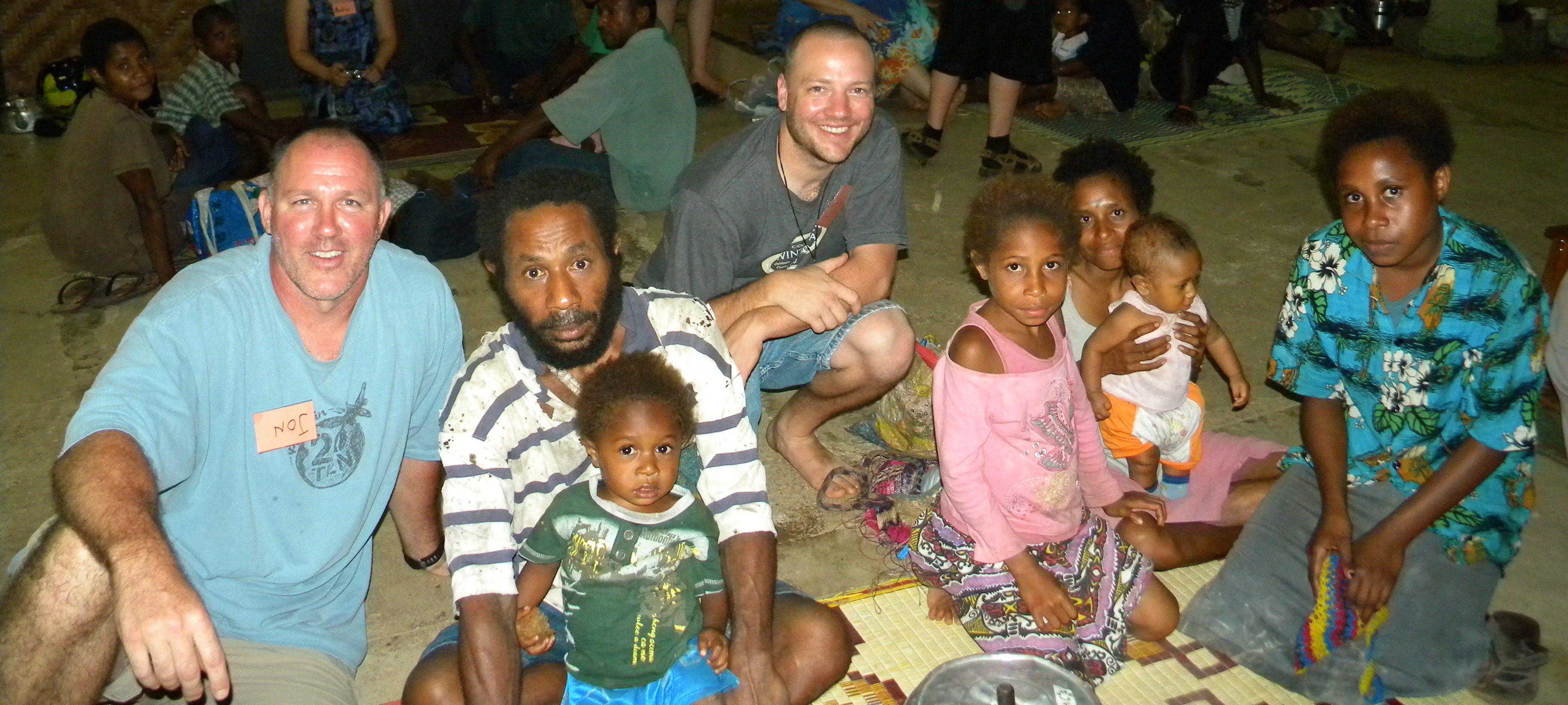
Saturday night was my final visit with my local wasfamili here at Nobnob. This time instead of me and my roommate going to their home they came to our haus kuk here at POC. This meant me and my roommate had to prepare dinner for us and the 6 them. We had a preparation talk from the staff and a town shopping trip earlier in the week to buy items for Saturday night. We decided to stay with the staples of choice: rice and beef stew. The next big step was actually preparing and making the dinner.

One twist to all of this is since PNG is an event oriented culture knowing their time of arrival is a complete guess. They told us at our last visit they would come in the afternoon. Well afternoon usually means anytime after 5:00 pm. We started cooking my baking dessert, brownies. We brought the fancy brownie mix from the Philippines, White King Brownies. We baked the brownies over a fire in a huge pot. In order to mimic an oven you place 1” of sand in the bottom of the pot. It works really well and the brownies were a hit with the family. We also added store bought Oreo’s. You definitely can’t go wrong with Nabisco Oreo’s.

After the pot oven, we kept the fire going for rice. Most PNG’ers don’t mine if their food is not hot straight off the fire. They eat their food lukewarm most of the time. We took advantage of this and started to cook 1 KG of rice or about 5 cups. Following that, I cut some carrots and one green pepper that I bought from the town market and boiled them down in water before adding the braised steak and onions for the stew. A neighbor kindly gave us a half of an onion to add as well. We warmed that over a slow fire until the family showed up at around 6:30 pm.

By this time it is about dust and we were getting hungry. It is normal to talk and story before dinner. We sat down, discussed the day’s events and of course the earthquake in Japan which caused a tsunami warning here. About 1 hr later, the family was ready to eat. Due to the time of year, it is rainy season and we were praying for a quiet night. Of course, it rained but it did not wash out any plans. The family was perfectly fine with sitting under the overhang of the dorms, out of the rain. We ate the rice, beef stew, and another pot of taro, greens, and bits of chicken that they brought. Believe it or not, every last ounce of 5 cups of rice was gone. And every last Oreo and brownie was eaten. The rain came and we stayed dried within the comforts of the company.

It was a pleasant evening despite the rain. I think I was more pleased by the way all the food came out. The waspapa did comment that he did like the food. He even had two big plates of the ‘gutpela kaikai.’ We have one more short visit where we will give gifts to show our appreciation to them.

Prayer Requests:
3 day survey hike (Mon – Wed)
Village preparation – buying food and supplies for 5 weeks

Praise:
Good Health

POC Video

Tok Pisin worship and dialogue, plus more

POC #3

It is hard to summarize or give an update when so much has happened since my last post which has been a couple weeks ago. Probably one the biggest reliefs is that I do not have to memorize any more Tok Pisin dialogues. All students were required to memorize a total of five dialogues and repeat each dialogue to our Tok Pisin teacher. If you watched my most recent video post, I included dialogue five at the very end to give you a perspective of the language.

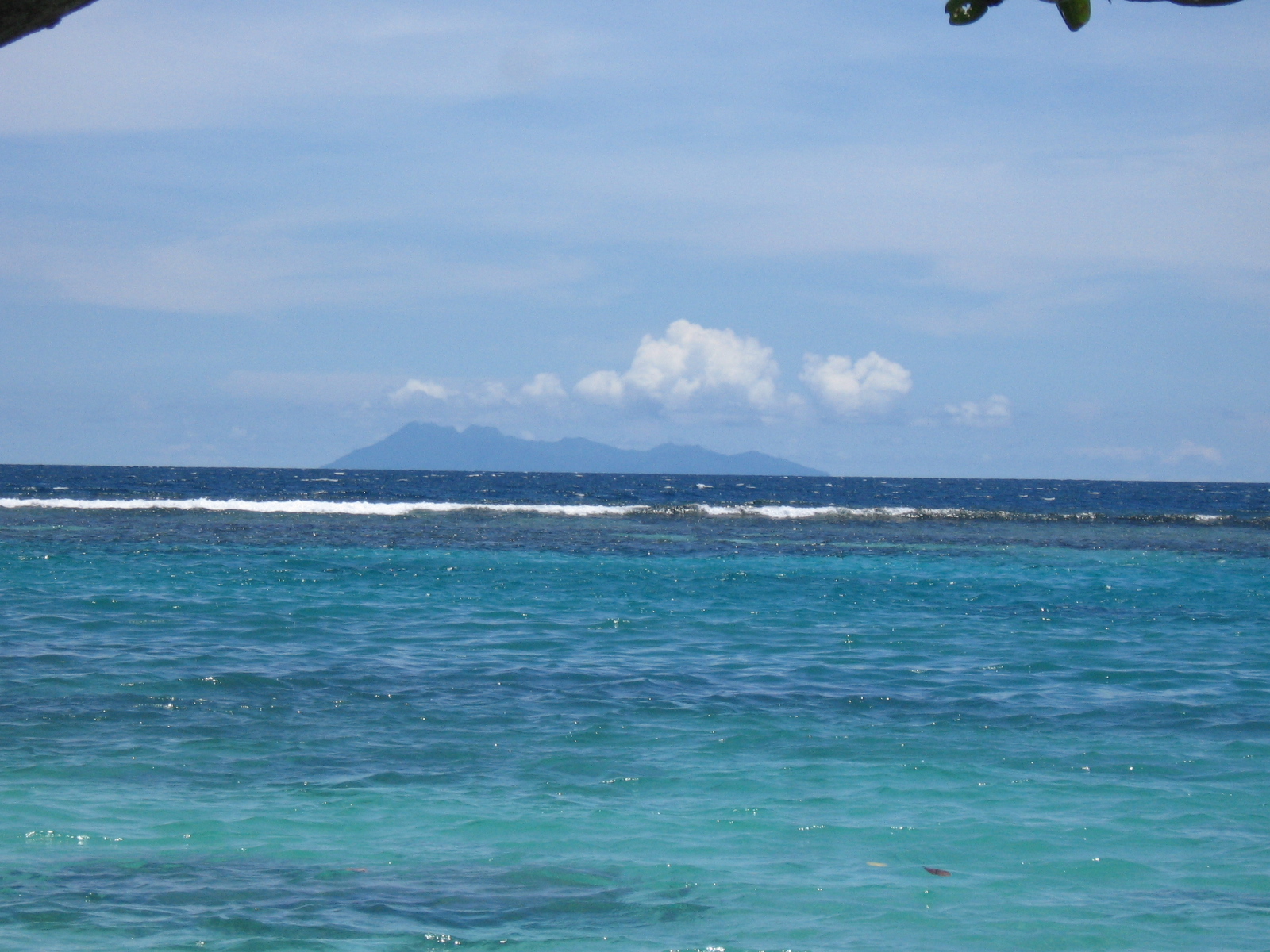
SIL-POC is split into two courses. One is designed for six weeks and the other for fourteen weeks. The biggest difference is six week participants live in the village for five days and fourteen week participants have five weeks of village living. Currently the six week students are in the midst of their village living. After completion they will leave POC and head their separate ways, most of them going to SIL headquarters in the Eastern Highlands and a few others going to Lae with the Evangelical Lutheran Church (ELC).  About two weeks ago we had a tropical delight, this is where we could get away for a day and escape reality with an excursion to the ocean. It was a short drive up the north coast to the village of Rempi. Here we were able to rest, swim, and snorkel. This was the first time I really got a good look at coral, reefs, and underwater creation. There were many fish of many colors plus starfish and living coral everywhere you turned. We got to swim over the reef and see where it dropped off dramatically. The reef ranged 3 – 15 ft below water level. Once it dropped off, it was like an underwater cliff. The light blue ocean turned a very dark blue quickly. I do want to remind you, it is not every day that I get to experience the paradise of Papua New Guinea though I do currently reside on the island paradise.

Now that the course has been split into two, the fourteen week group is starting to gear up for our five week adventure in the village. There are three pretty good hikes. We just completed our first hike which was an all day hike to a nearby village for lunch. The hike was 7.5 miles roundtrip trekking through the jungle. The village of Kamba was down the mountain, across the valley and then back up on the other side. On the way back following lunch we broke into three groups: fast, medium, and slow group. Of course I chose the fast group. The record was 1 hr 15 mins back to POC. Well, our group didn’t want to set the record and we really didn’t come close but we did make it back in 1 hr 30 mins. The medium group was about 1 hr behind us though. I do have to say my hiking in Alaska has been well worth it and very profitable here in PNG. The hikes haven’t been too challenging but the heat and humidity has been a big factor. We have two more big hikes.  The biggest hike will be a three day overnight survey hike to nearby villages. I love hiking and I look forward to this little adventure.

One of our class sessions was on the local anthropology. It was lead by the expatiate translator and a few other local men who work here at POC. They shared some very interesting insights into their past and views on missionaries plus the spirit world. The topic of death was brought up and they shared about spirits and what happened to the spirit of the dead. They said when someone would die, their spirit goes either to the north to an island or south along the coast somewhere. The spirit man of the village could recall the spirit with their bones. When the white missionaries came the people thought the missionaries were the spirits coming back from the dead. Could you image coming to a foreign land and the local people thinking you are their dead ancestors’ spirit?

Another quick missionary story is when the missionaries came to the village the local people would steal the shoes of the missionaries. It was their thinking that if they ate the shoes of the missionaries they could gain the strength that they bring with them. White skins were viewed to have power and strength that was supernatural. The local people wanted to gain this power or spirit by any means. Imagine chewing the souls of Nike shoes over a fire at night.

Last weekend during haus kuk we were to simulate gathering our own water. We had to treat all water as it was dirty. We had to boil water, collect rain water, or use another purification method. Fortunately we have been lucky that it has rained every weekend so gathering clean water was not hard. However, I have found Saturday’s excellent days to go to town. I go to town mostly for high speed internet and a good meal. Not that I don’t eat good here but every weekend we are responsible to cook our own food by open fire (haus kuk). So going to town for a meal is not a bad option. To get to town, you have to hail a PMV or Pubic Motor Vehicle. These either come in the form of a van or truck like figure. The fare is relatively inexpensive costly about $.75 one way. I will share an embarrassing yet learning story later about my PMV ride back to POC.

Prayer Requests:
Continue to adapt a learner’s role – language and culture
My village allocation for 5 weeks of living
– Pray for smooth transition
– Wasfamili I will be staying with
– Chances to share the gospel

Praise:
Good Health

POC #2

Nau em I de namba 7 mi skul long Tok Pisin. (Now it is day number 7 of my Tok Pisin school.)

This past week I learned a dialogue about a garden. Gardens here are the heart and soul of everything. Well, land is actually the means of life. If you have no land, you have no life. Land gives you gardens which produces food (kaikai) which allows you to live. Land is also a status symbol in the culture. The procedure of a garden are first you mark the ground then you cut the grass or bush. You need to allow time for the grass/bush to dry then you set fire or cook the garden. There is not much worry about wild fires here as the land is very green and rich. They only cut and dry what they want to burn. Green grass will not burn. After the land or garden has been cleared and burned then you break the ground and plant. To break the ground they do not use a shovel or spade or any machinery but a strong pointed stick. This is very hard work. It is the man’s job to work the garden and the woman’s job to come behind to gather the food. There are jobs men do and jobs women do. They do not mix jobs. Men work and women cook.

This past week we had a special guest who was in full time ministry with SIL (Wycliffe) for 29 years. She immigrated to PNG from Australia and married a native PNG man. This is not common and very high risk. In the end, she became a PNG resident forgoing her Australia citizenship. She had a wonderful marriage to this man though he suffered a fatal stoke a few years back. She talked to the group here the past few days on culture and history of PNG. A few things that tickled my ears were: PNG was originally split into Papua (meaning ‘fuzzing heads’ given by the Portuguese) in the south claimed by the British and New Guinea in the north claimed by the Germans. The west part of the island was controlled by the Dutch until 1960’s when Indonesia dropped in and force the Dutch out by military force. The Dutch had 24 hours to leave the island. From a culture perspective the #1 issue facing PNGers today is greed. People here want to get rich quick and make no effort in doing so. Right now, there is a deal on the table for Liquid Natural Gas (LNG). PNG is rich with natural resources such as nickel, copper, and natural gas. This LNG project is good and bad. The business entities need land to operate and the owners of this land want compensation immediately (greed). This ties back to land being central of life. No one can buy land. Land is owned by the community or tribe residing on the land. You can lease land but never own it. You can speculate potential problems that may arise. This is one of the major huddles facing land owners (tribes and communities) with the LNG project.

Last Thursday, my roommate and I were introduced to our wasfamili (watch family). We will be having five encounters with our wasfamili during POC. This gives each of us an opportunity to learn and experience the local culture and language. On Thursday my wasfamili came to POC for dinner. We were the hosts. My family consists of papa, mama, and four children. In the culture here it is socially appropriate for men to address men and women to address women. Being our specific case, we had one speaker being papa, his name is Hogg. The first visit we had rice and beef stew with bread rolls. My first experience with limited Tok Pisin language was very rough. I quickly ran out of words and questions to ask. There was plenty time to sit, stare, and think. Hogg mentioned before they left for the night that we had no stories to tell. He said after a few more weeks we will have plenty of stories to share. I hope he is right. This coming Thursday we are preparing to go to his home as they will be the hosts. This will be my first village experience. Looking to the weeks ahead, I will spend the night with my wasfamili, another village visit, and last we will entertain the wasfamili with a meal prepared by me and my roommate.

I also want to touch a bit on my first haus kuk weekend that I talked about last post. Last weekend was our first experience at cooking on an open fire for all meals on Saturday and Sunday. On Friday, I attend a bread making class  which I made 1 loaf of half wheat and half white bread and turned the extra dough into bread sticks. It turned out well. I was proud of myself. So for the first weekend we had fresh bread. Peanut butter and bread go a long way with two single men. Bananas, peanut butter and bread make an excellent breakfast. I didn’t starve but I didn’t eat the best. I was lucky to grab leftovers from the other families such as fried bananas and fried onion rings. Since my birthday was the week prior a group of girls wanted to celebrate by making brownies. On Sunday night we used a drum oven which you place over a fire to cook with. The brownies turned out pretty good for using the drum oven for the first time. I think it took a little over 25 mins to cook. I have no idea how hot the fire was but we kept it stoked and burning the whole time. That was a one person job alone.

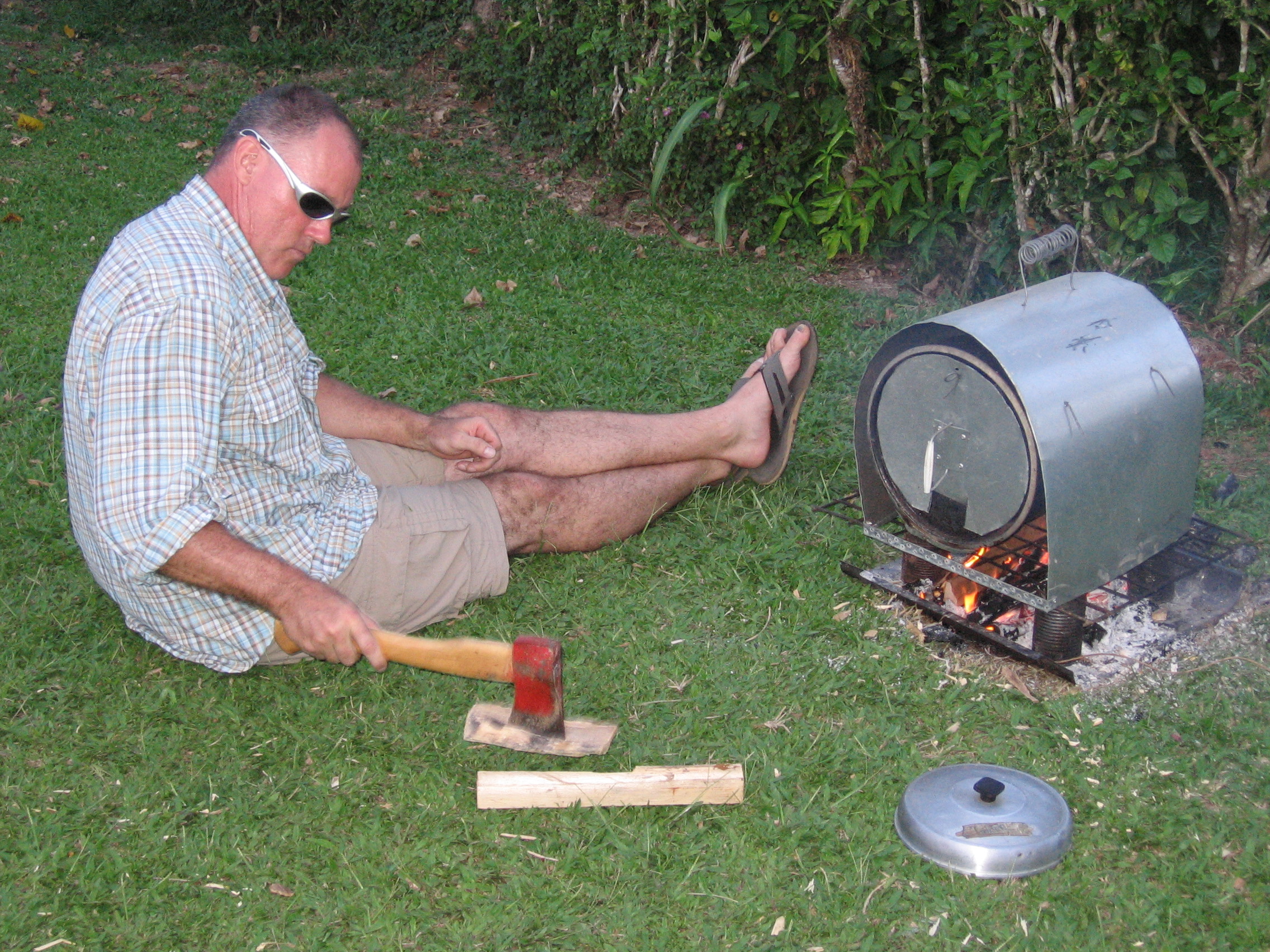
John tending to the drum oven

FYI: Where am I?

For the technical minded folks, here are my GPS coordinates +/- 20 feet.

S          05.09.567

E          145.45.067

Your best option would be input these coordinates into Google Earth. I am located about 1300′ above sea level and northwest of Madang.

Prayer Requests:
– Country of Papua New Guinea
(Political, Economical, Educational)
– Spiritual Warfare maintenance:
I was reminded this week that I am enrolled on the frontline of the battlefield. The enemy wants to attack my weapons (bible reading, devotion, prayer, etc.).
– Wasfamili
Courage, strength and knowledge to speak and converse with family
– Learning Tok Pisin
– Learning Culture

Praises:
Good Health
God’s Faithfulness

Driving up the mountain to NobNob (1200′ elevation), building a haus kuk, and living arrangements.

POC Week 1 and 2

Gude bruta na susa. Yupela stap orait? (Good day brother and sister. How are you?)

Today, we visited the village church nearby POC. POC is apart of the NobNob community and the church is a short quarter mile walk. The church has a bell ringing system of three rings. First ring, time to get ready for church. Second ring, time to start to go to church. Third ring, church is starting. Since PNG is an event orientated culture things do not start at a specific time. White skins are very much time orientated people. We are driven at an early age to be prompt and on time for school, dinner, ball practice, and bed time. Here in PNG they are all about relationships. People mean more than anything else and if church doesn’t start exactly at 10 am then so be it.

This past week I continued to learn Tok Pisin and had my first dialogue to memorize and recite to my teacher. There are a total of 6 dialogues that all students must memorize. Tomorrow we will be going to the town market with our Tok Pisin teacher to buy a few food (kaikai). The kitchen cook is giving us a list of items to buy. This will be another learning lesson on how to buy in the market and using our Tok Pisin that we are learning. FYI: You can’t barter for food that is being sold in the market but you can barter for non-food items such as clothing. There are also 400 different types of bananas but no matter which kind it is they are all simply called – bananas.

Other words:
rokrok – frog
pukpuk – crocodile
kakaruk – chicken
kokonas – coconuts
ananas – pineapple
popo – papaya

We also went swimming this past week and I swam 1600 meters or 1 mile. It was not a timed event so you could go at your leisure. Water are nice but not much of a reprieve from the heat. Water temps are low to mid 80s, I assume.

Saturday was a big day and that we constructed our ‘haus kuk.’ A haus kuk or kitchen is typically outside the home where all the meals are prepared. All materials were gathered for us plus the ‘sail’ or blue trap for rain/sun protection. Most materials were bamboo and sago which was used to build the table top. It is actually from the grass family. The ‘wokman’ or workmen built a demo on Thursday which took them 45 mins from start to finish. Saturday it took me and John (roommate) 6 hrs + to construct a full haus kuk. Later on in the course (next weekend) we will be responsible for cooking all meals with open fire and eat in our haus kuk.

Overall, things are going well. I am learning lots. I am feeling good about myself from this morning church service. I think I was able to pick up a good portion of the main words from the service. We had a chance to introduce ourselves at the end of the service and everyone did an excellent job with their 1 week of Tok Pisin. The church was Lutheran and had the typical readings and many prayers. They ended the service with ‘tok save’ announcements and praying the Lord’s Prayer.

I can’t say I miss the arctic temps in Alaska or anywhere else in the continental US. I heard another winter storm slammed the Midwest. It is pretty hot here at least when the sun is out. It was 95 in the direct sunlight Thursday afternoon. It cools down to 78 overnight which is welcomed but still warm.

Thank you for your prayers and support. Keep praying for me and all participants here at the Pacific Orientation Course. Check out my online photo gallery for pictures: http://picasaweb.google.com/thewitt05

Prayer Requests:
Learn Tok Pisin
Learn culture/anthropology

Praise:
Good Health

Pacific Orientation Course

As I wrap up my brief time in HOT Madang this week, I am leaving the city for the hillside of NobNob. I am beginning a 14 week orientation period where 8 weeks I will be living in a church camp style location learning culture, anthropology, language, and customs of the land. 5 weeks following I will be in a village putting to practice skills I learned. The final week will be debriefing back at NobNob.

I want to preface, that my internet functionality and availability will be very limited for the next few months. I understand there is a very slow, like a dial-up connection available to all participants. Understand I will still have internet and best communication will be email. I can’t promise weekly blog posts or updates. I will be capturing photos and journaling my adventures.

Continue to pray for me and keep me in your thoughts. I am honored to hear the many reports and comments that you are praying for me. There is great work to be completed here. Please pray for the team and the transition/change that is amidst the group. Pray that God will give the team a resilient attitude and an act of humility for the service of our Lord.

Journey from AK to PNG

My first video from PNG. I wanted to capture my Trans-Pacific journey from Alaska to PNG. I had stops in Seattle, Tokyo (Narita), Port Moresby before my final destination in Madang. Sorry it is a bit long but I hope you find it enlightening.